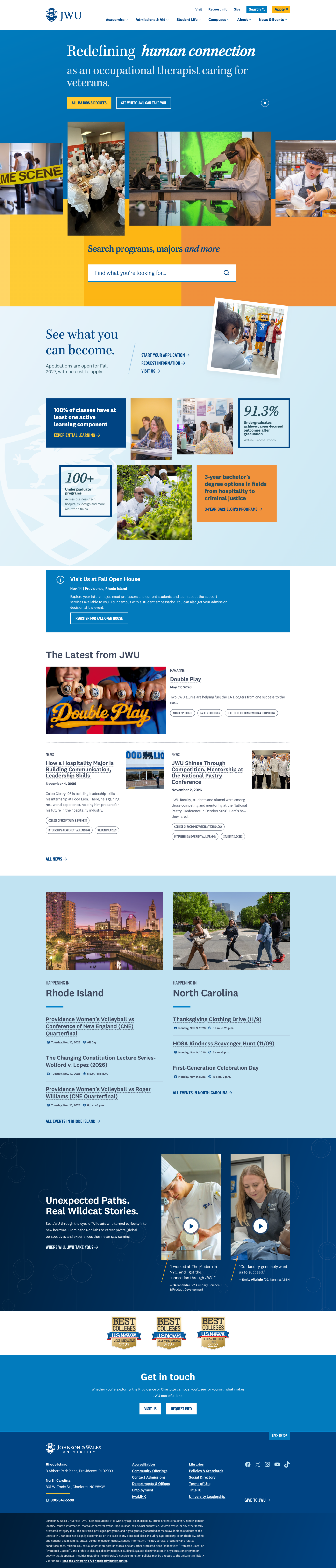
Nuts &
Bolts
Project Scope
- Discovery & Research Summary
- Project Strategy Blueprint
- On site meetings and trainings
- Audience research and strategy
- IA and navigation strategy
- content strategy
- SEO/GEO
- wireframes and design
- WordPress build
- Searchstax, Watermark, Livewhale, Sidearm, Courseleaf integrations
- Content work plan for up to 300 key pages
- Website messaging guidelines for the JWU brand
- Governance workshop, recommendations, and framework template
CMS
WordPress
Tech Platform
Pantheon
Integrations
SearchStax, Livewhale, Courseleaf, Watermark, Sidearm
Site Size
Approx. 1,900 indexed pages
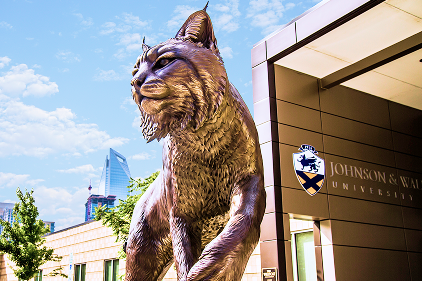
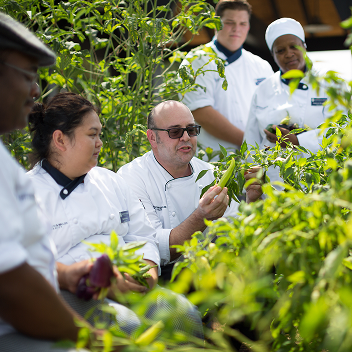
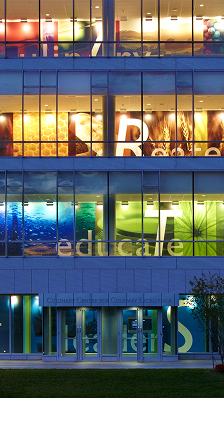
A comprehensive university, with culinary prestige.
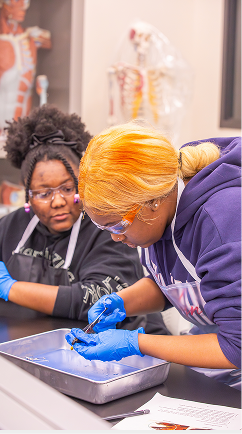
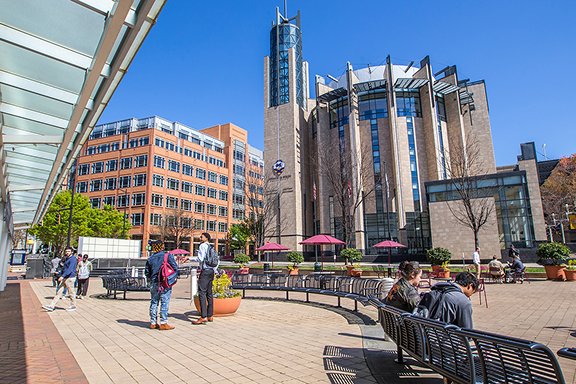
Johnson & Wales University, founded in 1914, serves more than 8,000 students in Providence, Charlotte, and online, with over 93 undergraduate and graduate programs. It was the first university to offer a career-focused three-year degree, and its alumni work in 128 countries. Despite its range of programs, most people still know it as a culinary school. As one administrator told us in discovery, “We’re so known for culinary and hospitality that that overshadows so much of the other great work that we do.”
JWU’s team had a clear vision for a new web presence that would address both public and internal stakeholder needs. After an RFP process that drew 32 responses, they chose NewCity because they wanted to work with a partner who would “not let anything fall off the plate.”
Going in, Matt Montgomery, VP of Marketing and Communications, described a “frankenstein monster” of unique challenges: decentralized governance, a 13-year-old CMS (plus 7 more in use across the system), and the AI search discoverability challenge “we’re all universally facing.” They were proactive about building that solution into their redesign from the start.
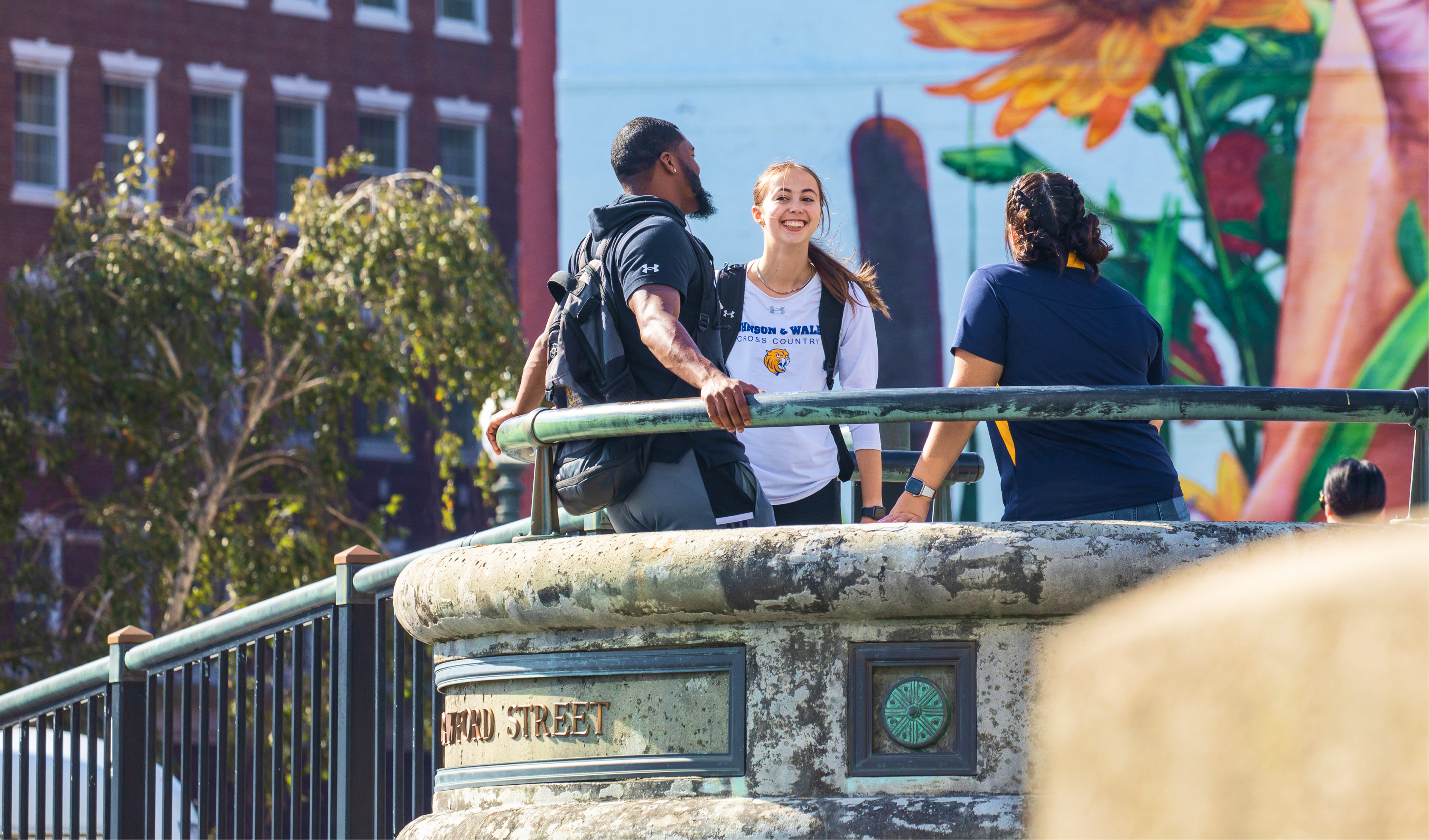
An evolving university
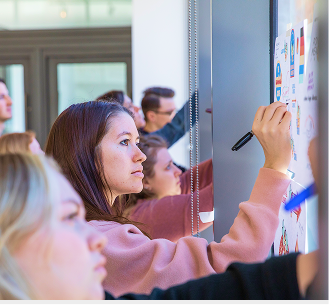
We kicked off the project with a team team onsite meeting in Providence. Our partnership was bolstered by audience research, which Matt later told us was “absolutely necessary for us to have internal governance conversations later, which all centered around what’s not working, what we know users want and aren’t getting”.
We found:
- Program pages obscured what students look for. An early RFI form and a “false footer” effect made testers stop scrolling, so many missed curriculum, internship stats, and salaries.
- Navigation was inconsistent. Testers skipped top-level pages, ignored the sticky nav, and scrolled back to the top for the menu.
- RFI forms interrupted the search. Admissions pages drew strong engagement while RFI forms underperformed. On the online homepage, a form disguised as a program finder turned off most testers by asking for personal information before they got any program information.
- Campus locations were unclear. Only one tester correctly identified all three locations, and most placed JWU in Charlotte. Program pages also gave little sign that a program is offered on both campuses.
Their main goals were to:
- Solve their usability issue around the two campuses, and help users understand the structure and locations of JWU.
- Increase awareness of JWU as a 4 year university with strong program offerings, where culinary focused students could get a “normal” college experience, and where non-culinary students could learn in a practical and innovative environment
- Move to a centralized web governance model, lead by marketing, and help empower editors to be storytellers
- Increase AI and GEO search discoverability
With a roadmap in place, the team moved onto the CMS evaluation. JWU knew they wanted to use an AI search tool before they chose a CMS. After an exhaustive review, they chose WordPress because it matched their team’s skills, moved governance from IT to marketing, and allowed new features to be added without custom coding.
What surprised the team was how central SearchStax became to the project. As NewCity web developer Mike Henderson said, “it wasn’t just a plug-in, it was a true integration. He added, “but it wasn’t an out-of-the-box thing. You have to create what you want to see.”
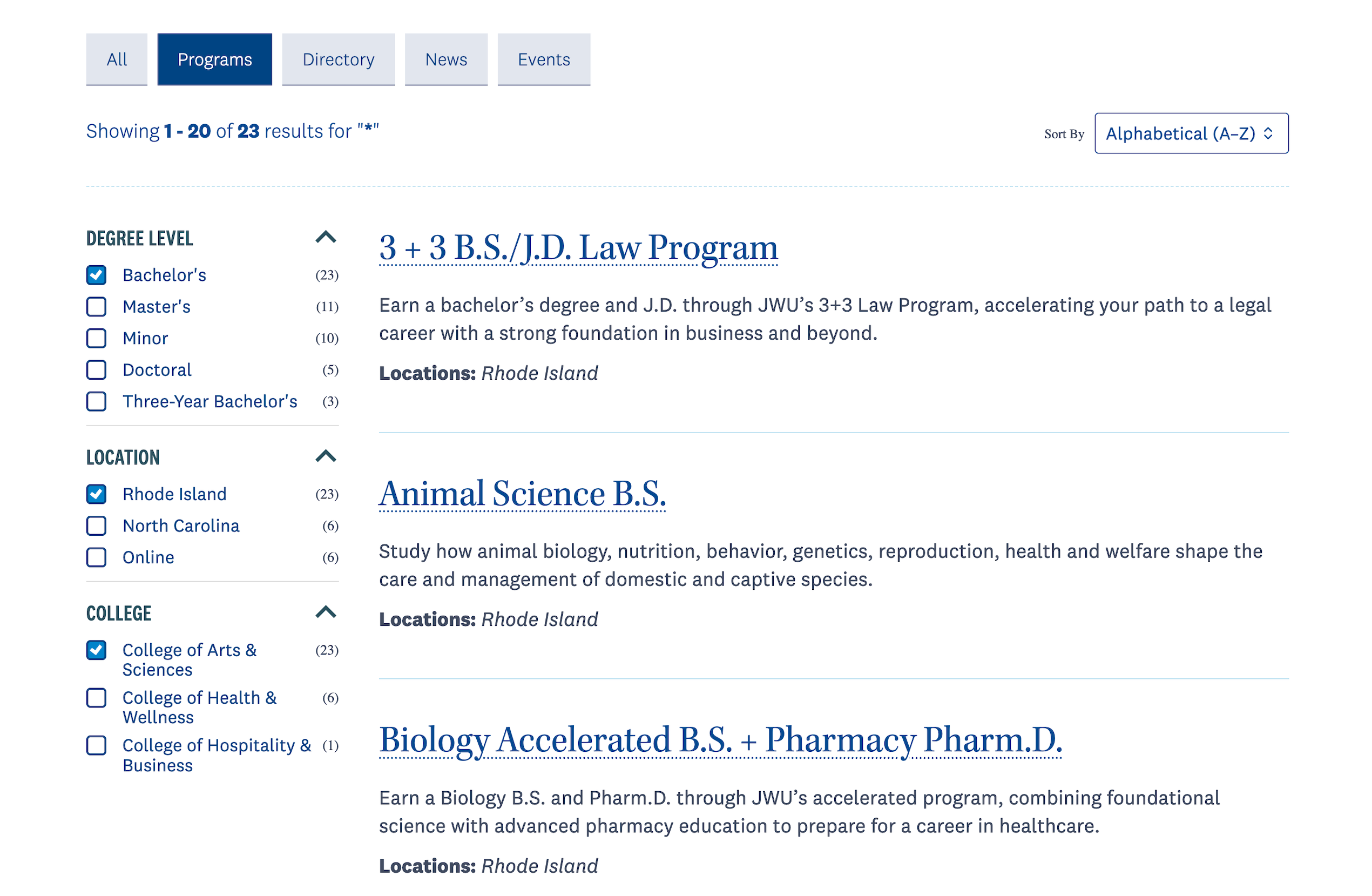
Search tools are often added after a site is built, crawling existing pages and returning a standard list of results. For JWU, we built the CMS, content model, and taxonomies together, around how SearchStax works, so visitors can browse results in tabs for degree programs, faculty profiles, news, and events. Within each tab, filters help visitors narrow what they see, such as event type, audience, and campus. To make that work, we planned the categories behind each filter with JWU’s team early in the project, and the site passes that information to SearchStax in a structured form it can read.
The program pages show what this structure does for visitors. JWU has two campuses, and the old site didn’t always make that clear. Some students toured the wrong campus for their major, and visitors who landed on a Providence program page assumed that was their only option. So we built each program page as a content hub that answers key questions in one place. Each hub highlights campus locations, degree versions, and the full curriculum, so visitors can compare options without leaving the page. Search supports the same idea. Programs can be filtered by college, degree level, and campus, and results in the Programs tab lead to the main program page, so students see the full picture.
Fast Facts
JWU’s site, platform, and integrations were designed to work as one connected system. Content flows in from the integrations that manage it, editors focus on storytelling, and AI search has structured pages to scan. The results below show what that changed.
180 to 15
Web editors after centralizing governance
17-1
Subdomains consolidated into a single site
7-1
CMSs consolidated into one platform
100%
Faculty profiles automated through Watermark
Two other integrations, Watermark and Livewhale fed faculty profiles and events information content right into the CMS without those editors needing to touch the WordPress site. We also integrated the course catalogue through Courseleaf, so users could explore curriculum within program pages. This supported the centralized governance model, reduced Marcomm’s content management burden and gave AI more structured content to parse for search results.
How this solution met their goals
- Governance: Editors dropped from about 180 to about 15. The Watermark faculty directory replaced a dozen editor groups and made profiles 100% automated. Sidearm feeds athletics schedules, and student clubs post events without WordPress access.
- One site: 17 subdomains became a single site, which Matt and Laurie both tied to search performance and a better user experience.
- AI discoverability: Structured program pages, a public calendar and career feeds give AI search content to reference. NewCity built 10 SEO-optimized program pages plus an outline JWU is using for the rest.
- Two campuses: Hubs and campus navigation address the confusion. Usability testing showed everyone identified the states correctly.
Problem-solving through the build
This was a complicated WordPress build, with many first times for most of our team. As Project Manager Rachel Easterbrook put it, “the layers of integration made layers of decision making we really had not encountered before, and just increased the complexity at every turn.” The project also showed how much WordPress can do: developer Mike Henderson called it a testament to “the flexibility of WordPress.”
JWU took that complexity in stride. Matt Montgomery described the intent as designing the site’s infrastructure so “we will need fewer hands on it.” Our project management and problem-solving, combined with JWU’s commitment, carried both teams through each challenge.
Early results are strong
Launch day marked a successful shift from a decentralized web governance model to a centralized one led by marcomm. Seventeen subdomains became one site, and 180 web editors became about 15, with faculty profiles now automated through Watermark.
Post launch usability testing told us:
- Navigation was frictionless. Testers used menus and located info with ease.
- Locations were clear. All testers identified Providence, RI and Charlotte, NC correctly.
- Programs were easy to find, through the new primary navigation and through search.
While we’ll need at least 90 days to get a telling read on post-launch metrics, the JWU teams has already seen some promising AI search results in their dashboard data.
The JWU team is happy to have launched the site that they envisioned. Laurie Roberts is “amazed we got it done in a year” and says, “I really don’t think we would have been as successful” without NewCity.
The NewCity team feels the same pride in JWU. “I’m proud of the client,” says NewCIty Director of UX and Content Strategy Rachel DeLauder, who credits them with their fair share of the project’s success. Mike Henderson describes an informed team that arrived with questions at every meeting and challenged NewCity “in a good way.” If Matt’s vision for the site was a “sustainable and manageable system, with building blocks we’ll need to keep innovating for years”, Rachel Easterbrook is confident that they’ll succeed, “because their team is so excellent, and they rose to the challenge of owning it.”
Pharetra Egestas Fringilla Amet Condimentum
Cras justo odio, dapibus ac facilisis in, egestas eget quam. Nulla vitae elit libero, a pharetra augue. Duis mollis, est non commodo luctus, nisi erat porttitor ligula, eget lacinia odio sem nec elit. Cum sociis natoque penatibus et magnis dis parturient montes, nascetur ridiculus mus.
Cum sociis natoque penatibus et magnis dis parturient montes, nascetur ridiculus mus. Nullam id dolor id nibh ultricies vehicula ut id elit. Fusce dapibus, tellus ac cursus commodo, tortor mauris condimentum nibh.