
Nuts &
Bolts
Timeline
November 2022 – April 2024
Project Scope
- Discovery
- UX research
- Content Strategy
- Information Architecture
- Design System
- Front-end development
CMS
Cascade by Hannon Hill
Component Library
Storybook
A system that was built to last
King’s College is a catholic school located in Wilkes-Barre, Pennsylvania, one of the most competitive private college markets in the country. When first-year enrollment declined through 2022 and 2023, leadership responded fast: they reallocated their marketing budget to 75% digital, voted to invest in a full website redesign, and set a clear goal. Make the site a viable recruitment tool.
That decision led them to NewCity and Hannon Hill.
Time for a technical and strategic shift
King’s was running on 10-year-old Drupal 7 infrastructure with no staging environment and no way to review content before it went live. More than 50 editors had direct publish access with no approval workflow, and fragmented systems duplicated the same type of content in different ways (for example, there were three different campus calendars).
The old system gave editors one template to work with. If campus stakeholders needed to address different audiences, a developer needed to build those templates by hand.
The content had accumulated structural problems too. “There were too many pages dedicated to one subject, “ said Ryan Kiernan, King’s Web Services Manager. “A big part of the work I did before launch was removing redundancies and reducing the number of clicks to find valuable information from a prospect’s viewpoint.”
NewCity’s usability testing reflected an issue King’s was aware of. Prospective students were struggling to find internships and career outcomes because navigation didn’t match how they searched. Every friction point was a potential loss. “It’s been a challenge to help everyone understand that the website is a conversion tool,” Ryan said, “that a significant number of applications are fed through the website.”
The Research "Bombshell" that opened minds
NewCity’s UX research shaped both site strategy and internal thinking at King’s. We conducted internal stakeholder interviews, audience research (prospective students, parents, high school counselors) and usability testing on the existing site. We also looked at analytics to gauge site-wide usage and in-page engagement with key pages. Qualitative research revealed not just how the website was functioning, but how and why it needed to achieve more. That research shaped the information architecture, content priorities, and development of a component library to support those communication needs.
The research also shifted how King’s thought about recruiting. Ryan said: “a lot of recruiting today happens on phones, tablets, and computers, not just in person at the high schools. The UX report made that case in very clear terms. Some of the later employees I shared it with described it as a bombshell — a really powerful explanation of why websites are important in the enrollment process.”
When Hannon Hill built the Cascade CMS implementation, they were building around a system already grounded in how King’s key external users think and what King’s editors needed to support the information needs of both internal and external audiences.
Designing a brand that flexes across the system
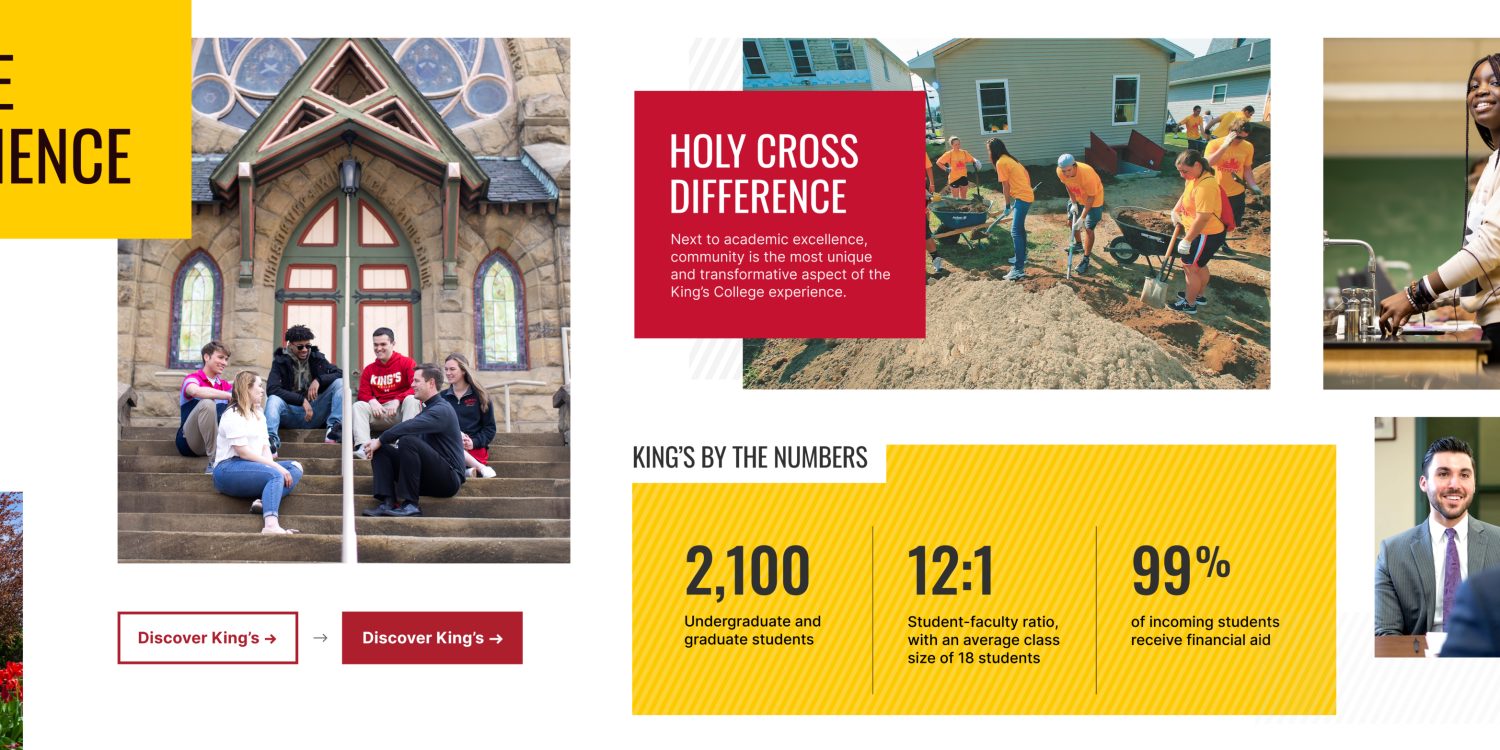
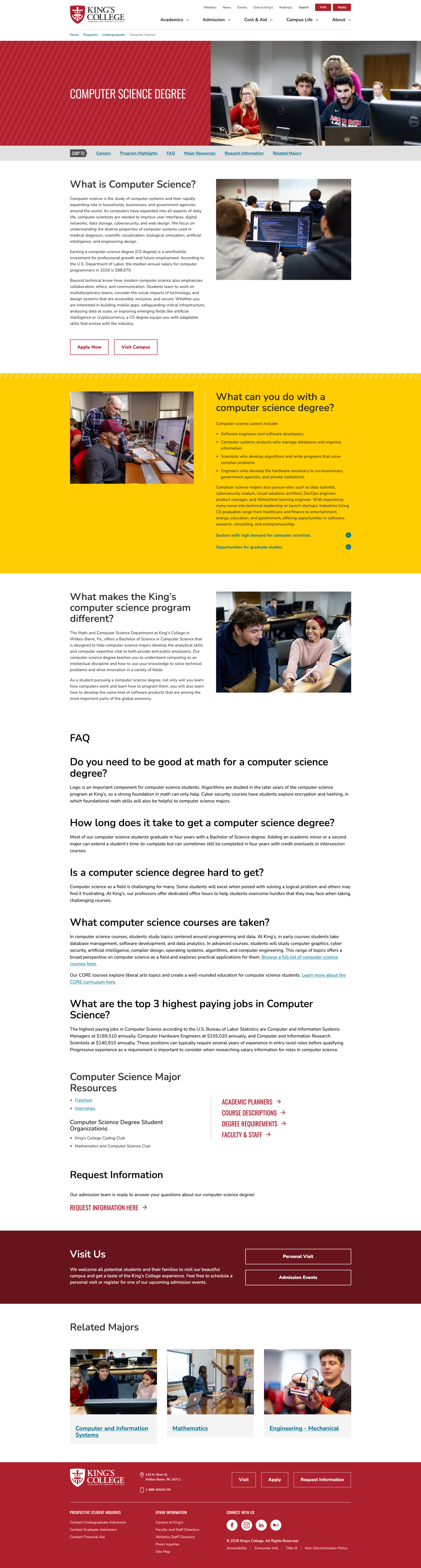
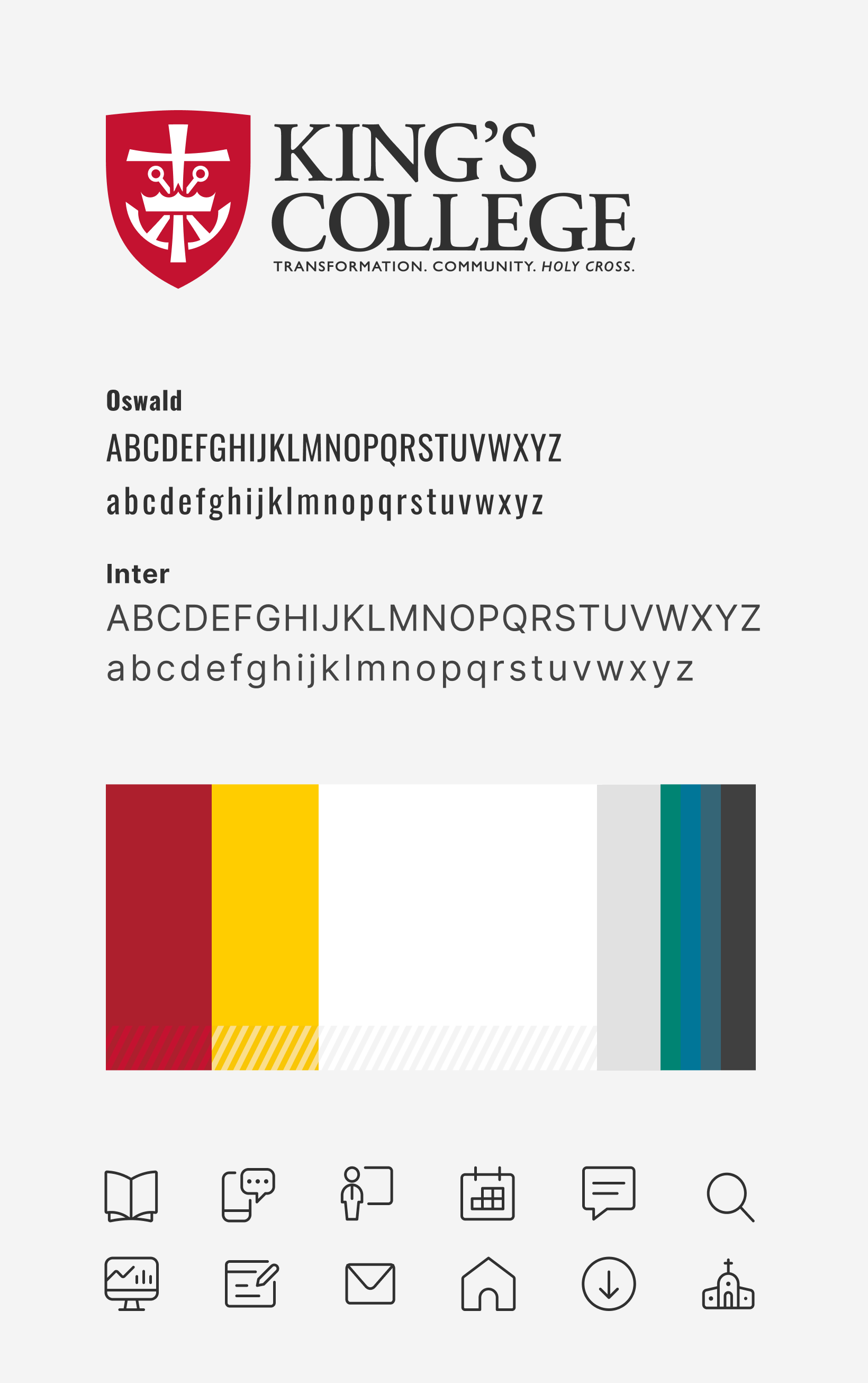
King’s had recently completed a rebrand, with a strong focus on their enrollment messages of access, affordability, and upward mobility. Our job was to maintain the brand across the site– translating identity into a component system flexible enough for real editor options, consistent enough to protect the brand everywhere.
As Rodger Bridges, NewCity’s Design Director, puts it: “Strong systems don’t eliminate creative possibilities – they create the conditions for them.” The old system’s rigid templating meant any variation required a custom build. The new component library let a program page, a faculty profile, and a campaign landing page each feel distinct while remaining unmistakably King’s. Navigation was redesigned around how prospective students actually think, not how the institution was organized internally.
A system built to scale – and a CMS that made it governable
The component library – built by NewCity in Storybook, implemented in Cascade by Hannon Hill – gave King’s two distinct structural advantages. First, Hannon Hill implemented Cascade using structured content types for information like academic programs, faculty profiles, and events. These allow authors to enter content within defined fields, ensuring data and design consistency across the site while still giving editors flexibility.
Second, reusable content blocks allow administrators to update something like an admissions deadline in one place, without hunting it down across multiple pages – reducing editorial burden and the risk of publishing outdated information. This also made it possible for Ryan to optimize over 60 program pages for search engines during the year after the site launch.
The Cascade CMS also helped the team develop a governance plan that worked for them. Where before King’s had no staging environment and no content review process, Cascade let them scope access, stage changes, and route content through approval. Leadership changes after launch meant King’s moved toward a centralized drafting and approval process within marketing – but the platform made that quality control possible. Now they have a governance system and tools in place that they can adapt to their unique organizational priorities.
Two years later, the numbers are worth celebrating
Slate form submissions up 23.4%
Comparing May 2024–May 2026 to the prior two years, Slate form submissions (event registrations, applications, deposits) increased by 23.4%. “That’s pretty telling,” Ryan said, “considering that’s our major metric in terms of engagement with the site.”
Organic traffic up 10%
King’s grew its organic session share from 62% to 68% – roughly a 10% increase in engaged sessions. Most institutions have seen organic traffic drop 10–15% since AI-generated search overviews became prominent. King’s grew through that headwind, in part by optimizing 60 program pages for search engine performance in 2025 – work the structured content model made tractable at scale.
First-year and graduate student enrollment at a six-year high
First-year applications, admits, and net deposits are all at a six-year high in 2026. The website, the shift to digital marketing, and a sustained SEO effort all contributed – and all depended on a site built to support them.
PROJECT HIGHLIGHT
Baseline Usability Testing
We tested the existing King’s site with prospective students by asking them to complete five tasks we’d identified as high-priority communication tasks for both the students and the institution. Here’s what we found, and how we acted on it.
Discovery:
- Internships: Students couldn’t find major-specific internship information, a key King’s differentiator, without significant searching.
- Scholarships: Financial aid information was hard to locate and harder to parse.
- Career outcomes: “Employment” as a navigation label confused students looking for job placement data.
- Accreditation: Students couldn’t find accreditation information on program pages even when it was there, undermining program legitimacy.
- Events: Calendar content was fragmented across multiple systems, making it challenging to find admissions or other student-facing events.
Solution:
- Internships: Consolidated special programs content and surfaced it more directly from individual program pages.
- Scholarships: Restructured financial aid navigation and simplified content hierarchy and language.
- Career outcomes: Relabeled and reorganized outcomes content around student mental models
- Accreditation: Integrated accreditation details directly into program page content, making it easy for prospective students to confirm a program’s standing.
Events: Consolidated public-facing events into a single, clearly labeled destination, now independently managed by King’s PR team.


Have questions about design systems?
We love talking about all things web design, development and digital strategy. Reach out to discuss how we can support your goals.